Haven House
Unchosen By My CEO Husband: A Marriage In Crisis Second Chance RomanceHaven House is the lakeside refuge at Bellweather Cove that Jacinta Colt chooses when remaining in the Colt household would mean continuing to manage a false public story. Left to her by her grandmother, it begins as a place of withdrawal for Jacinta, Willa Colt, and Theo Colt, but develops into a deliberately organized space of recovery, work, and renewed agency. Its decisive significance lies in the way it changes separation from a temporary retreat into a livable alternative.
Definition and Setting
Haven House stands at the lake in Bellweather Cove, the grandmother’s house that Jacinta identifies as the destination for herself and the children when Aaron Colt asks her to cool off rather than confront the marriage’s underlying crisis. The choice is precise rather than impulsive: Jacinta has already emailed the school, packed her laptop, and prepared the children’s duffels. She does not leave for an unspecified hotel or accept the temporary arrangement Aaron proposes; she names a place that belongs to her family history and can hold a future beyond the Colt household.
The house is initially unfinished as a household. When Willa Colt brings Jacinta a tablet at breakfast, Theo Colt eats dry cereal from the box because Haven House has “no systems yet,” and Willa becomes its temporary manager. The detail gives the location a material, domestic identity: it is not presented as a polished sanctuary awaiting its inhabitants, but as a real home whose routines must be made. Its lack of systems marks both the disruption caused by departure and the freedom to construct different ones.
The Departure and Its Immediate Function
Jacinta’s arrival at Haven House follows a confrontation in which Aaron reads the suitcase, garment bag, and children’s duffels as evidence of a decisive break. She tells him that the children are going with her and rejects his claim that disappearing will confirm Beatrice Colt’s allegations about her mental stability. Her accusation is that Aaron is not asking her to stay for the sake of their relationship; he is asking her to keep managing the story. Haven House therefore becomes the physical answer to a conflict over narrative control. At the house, Jacinta can stop performing stability for the Colt family and begin preserving evidence of what happened.
The departure is quiet in its execution. Willa buckles herself in and then buckles Theo, whose dinosaur shirts are packed in a suitcase; Jacinta backs out of the driveway slowly, without a screech or spectacle. From the car, she sees the former house with its lights on, labeled bins arranged by the door, and rails running in every direction except the one she is taking. Haven House is consequently defined against the old domestic order: it is reached by leaving behind a system that looked controlled but directed Jacinta everywhere except toward her own choice.
The house also carries the first archive of Jacinta’s new independence. Her laptop contains a folder titled “Recipes,” which is in fact where she is keeping the evidence, while a ten-year-old piece of paper rests against her skin and explains the marriage in Aaron’s handwriting. Haven House is thus both shelter and working archive. Its walls give Jacinta distance from the Colt household, while the documents she brings into it allow her to convert private memory into a record that can be examined.
Domestic Reconstruction and Expansion
Six months after the move, Haven House has systems. A launch pad stands by the door, with three bins assigned to Willa, Theo, and Jacinta; a four-color whiteboard calendar organizes the household; and the seven o’clock alarm still reads “WOMAN,” although some mornings it does not win. These arrangements do not erase Jacinta’s old habits of filing, labeling, and scheduling. Instead, they are retained, sanded down, and refinished for a life in which order serves the people living there rather than the appearance of an intact marriage.
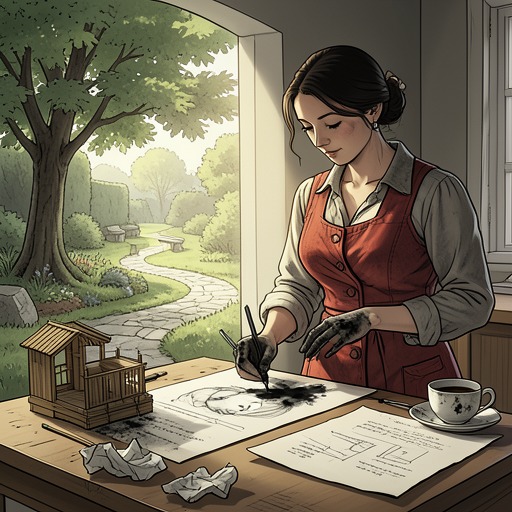
The location gradually expands in Jacinta’s imagination from a private house into a possible care setting. During a sleepless night, she draws the neighboring camp as it could become: gardens first, quiet rooms with soft light for days when the world is too loud, a kitchen with bins and labels, a four-color calendar, and a porch light left on. The design is grounded in her knowledge of what helps someone like her. Haven House therefore generates an institutional vision from domestic experience; its practical objects and routines become the beginnings of a larger environment for healing.
Noah’s work on the porch railing gives the house another governing image. He rebuilds it one board at a time, and Jacinta connects rails with promises and with men who do what they say they will do. In Haven House, repair is not an abstract declaration but a repeated physical act. The railing, the launch pad, the bins, the calendar, and the porch light all make reliability visible through structures that can be used and maintained.
Public Exposure and Ethical Conflict
The house does not remain outside public life. An article finds Jacinta at the lake, and Willa brings the tablet to the breakfast table to tell her mother that she is in the news. Haven House thus becomes the setting from which Jacinta’s withdrawal is observed and interpreted by society pages, even as the household itself is still improvising its routines. The contrast matters: the public sees a story about a woman at the lake, while the children and Jacinta are dealing with cereal, school, packed belongings, and the labor of making a home function.
The Colt family’s response clarifies what Haven House opposes. Beatrice Colt comes uninvited to Aaron’s office and complains that Jacinta is “playing pioneer woman for the society pages.” Aaron rejects that framing, insisting that Jacinta is not playing at anything. Beatrice’s earlier actions had included seating Jacinta like a coat check, erasing her name from her own project, and publicly diagnosing her before the crowd at the Renewal Centre Gala. Against that history of staging and erasure, Haven House offers a place where Jacinta’s actions can be understood through what she builds rather than through the family’s diagnosis of her.
The same ethical reorientation later shapes Aaron’s conduct. After reviewing the Northlight Consulting file, he learns that ninety-five thousand dollars was paid in consulting fees without contracts or deliverables, through a Delaware mailbox, with Celeste Colt approving every payment and Beatrice knowing about the countersigned records. At the foundation vote, Celeste resigns and the matter is referred to the state’s attorney; Beatrice is removed as chair. Beatrice protests that Aaron has chosen Jacinta over his own blood, but Aaron answers that Jacinta was always present and that his mother taught him not to see her. Haven House is not merely the place where Jacinta waits for this reversal. It is the absent center around which Aaron’s new recognition of responsibility forms.
Narrative Significance
Haven House changes the meaning of leaving. At first it is the destination of a woman refusing to remain inside a marriage whose public image has displaced its truth. The highway north leads toward the lake and toward a house inherited from the grandmother who left it to the granddaughter everyone had counted out. For the first time in ten years, Jacinta does not check the clock; the old timetable no longer governs the decision.
Its deeper importance comes from the combination of refuge and method. Jacinta brings evidence into the house, establishes routines for the children, and imagines gardens, quiet rooms, organized kitchens, and a light left on for people who need somewhere to go. Haven House consequently becomes a counter-structure to the Colt family’s system of concealment: where that family manages appearances, the house preserves records; where the family assigns instability to Jacinta, the house makes room for her practical intelligence; where promises were spoken and broken, its rails are rebuilt board by board.
By the later stages of the story, Haven House signifies not retreat from life but the possibility of designing life on accountable terms. Its unfinished beginnings, visible systems, public exposure, and projected expansion all belong to the same arc: Jacinta turns a grandmother’s lakeside property into a place where survival can become organization, organization can become care, and care can become a future that no longer depends on being granted recognition by the Colt household.